Canadian Plumbing Code Explained for Homeowners: What a Licensed Plumber Must Follow Before Starting Your Project
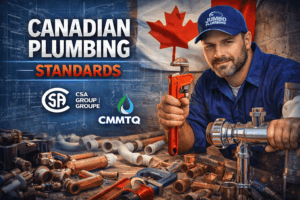
Every licensed plumber in Canada must follow the National Plumbing Code of Canada (NPC) and provincial amendments before touching a single pipe in your home, ensuring your bathroom renovation meets safety standards, passes inspection, and protects your investment.
Key Takeaways
Knowing the Canadian plumbing standards is essential before starting any bathroom renovation:
- The National Plumbing Code of Canada (NPC) was last updated in 2020 and serves as the baseline for plumbing rules nationwide.
- Improper venting, incorrect drainage slope, and undersized pipes are among the most commonly identified plumbing issues during Canadian home inspections.
- Plumbing inspections occur at multiple stages of a renovation, especially during rough-in, where drain, vent, and supply lines must be verified before walls close. Local permitting guides reinforce this requirement.
- Insurance companies may deny water-damage claims linked to non-compliant plumbing or unlicensed work, making code compliance crucial for homeowners.
- Bathroom plumbing rough-in costs in Canada vary widely, influenced by layout changes, fixture counts, accessibility needs, and regional labour rates. Renovation cost guides show broad ranges, so homeowners should obtain multiple quotes.
- CSA-certified plumbing fixtures and materials are required for most residential installations in Canada, ensuring quality, performance, and code compliance.
What Are the Canadian Plumbing Standards?
Canadian plumbing standards establish the framework for safe, reliable plumbing installations across the country. The National Plumbing Code of Canada, developed by the National Research Council of Canada, outlines minimum requirements for plumbing system design, installation, and maintenance. This comprehensive document addresses everything from pipe sizing and material specifications to drainage slopes and venting configurations.
The NPC functions as a model code that provinces and territories adopt, either entirely or with specific amendments reflecting regional conditions. This system creates baseline uniformity across Canada whilst allowing local adaptation. British Columbia includes additional seismic requirements due to earthquake risks, whilst Quebec has integrated plumbing standards into its broader Construction Code with distinct requirements.
The CSA Group plays a crucial role in Canadian plumbing regulation by developing product certification standards and testing protocols. When you see a CSA mark on plumbing products, it signifies the item has been tested and meets specific safety and performance criteria. This certification system ensures materials used in Canadian homes meet consistent quality benchmarks regardless of where they’re manufactured.
Knowing who sets the national plumbing code in Canada helps homeowners appreciate the rigour behind these standards. The National Research Council collaborates with industry experts, engineers, health officials, and building professionals to develop code requirements based on research, field experience, and evolving building science.
Planning a bathroom remodel? Knowing the code requirements starts with hiring the right professionals. Explore our plumbing services to ensure your project meets all Canadian standards from day one.
How to Find Plumbing Services That Meet Current Canadian Plumbing Codes
Finding plumbing services that meet current Canadian plumbing codes requires homeowners to verify actual credentials beyond advertisements. Start by confirming that any contractor you consider holds valid provincial licensing. Each province maintains a licensing board or trade authority that registers qualified plumbers who have completed apprenticeship requirements and passed certification examinations.
Code-compliant contractors demonstrate their expertise through specific markers. They should readily provide their licence number, carry liability insurance, and discuss permit requirements without hesitation. When interviewing potential contractors, ask how they stay current with code changes. The National Plumbing Code undergoes revision every five years, and provinces may implement amendments between major updates.
Request detailed written estimates that break down labour, materials, and permit costs separately. This transparency allows you to verify that approved materials are specified and permit fees are included. Be cautious of contractors who suggest skipping permits to save money—this approach creates liability for you as the homeowner.
Before signing any contract, ask these critical questions: How long have you been licensed in this province? Can you provide references from recent projects similar to mine? Will you obtain all necessary permits? What inspection stages are required? Who will supervise the daily work?
Where to Hire Plumbers Compliant with Canadian Plumbing Standards
Locating plumbers compliant with Canadian plumbing standards begins with provincial licensing boards. In Ontario, the Ontario College of Trades maintains databases of certified plumbers. British Columbia uses SkilledTradesBC, whilst Alberta relies on Alberta Apprenticeship and Industry Training. Quebec homeowners verify through the Régie du bâtiment du Québec. These organisations provide online search tools where you can confirm a plumber’s certification status and check for disciplinary actions.
Finding a list of certified Canadian plumbing standard contractors near you involves multiple verification steps. Start with your municipal building department, which often maintains lists of contractors who regularly pull permits in your area. Professional associations like the Canadian Institute of Plumbing and Heating (CIPH) maintain member directories where you can search by location and specialty.
Red flags signal contractors who may not prioritise code compliance. Be wary of anyone who cannot immediately provide a licence number, seems unfamiliar with local permit requirements, or pressures you to start work before inspections. Contractors who exclusively request cash payments, lack proper business insurance, or cannot provide fixed business addresses present serious risks.
Written compliance guarantees provide important protection. Professional plumbers should willingly document that their work will meet all applicable codes and pass required inspections, specifying they’ll correct any deficiencies identified during inspection at no additional cost.
Don’t risk your renovation on unlicensed work. Contact our certified plumbing team for bathroom remodel plumbing that meets every Canadian code requirement.
Is CSA Plumbing Code Mandatory in All Provinces?
The CSA plumbing code’s mandatory status varies by province, though the National Plumbing Code of Canada forms the foundation across the country.
| Province/Territory | NPC Adoption | Additional Provincial Requirements |
| Ontario | Yes (with amendments) | Ontario Building Code supplements NPC |
| British Columbia | Yes (with amendments) | BC Plumbing Code has specific seismic requirements |
| Alberta | Yes (with amendments) | Alberta Building Code references NPC with modifications |
| Quebec | Modified adoption | Construction Code of Quebec has distinct requirements |
| Other Provinces | Yes | Generally follow NPC with minor amendments |
Provincial authority over building codes stems from Canada’s constitutional framework, which grants provinces jurisdiction over property and civil rights. Each province can determine how it adopts and modifies the model National Plumbing Code.
Are there differences in plumbing codes by province? Absolutely, though core principles remain consistent. Variations typically address regional climate conditions, local material availability, specific environmental concerns, or unique construction practices. In British Columbia, seismic requirements mandate specific pipe support and flexible connections. Ontario’s amendments often address climate-specific concerns like frost protection depths. For bathroom renovations, these differences might affect minimum pipe sizes, required fixture spacing, backflow prevention requirements, or inspection procedures.
Which Plumbing Products Are Certified Under Canadian Standards for Home Use?
Plumbing products certified under Canadian standards for home use must bear proper certification marks indicating they’ve undergone rigorous testing. The CSA certification mark remains the most recognised symbol, but equivalent accredited testing agencies like ULC (Underwriters Laboratories of Canada) also provide acceptable certifications.
Approved pipe materials under Canadian standards include several options, each with specific applications. Copper pipes (Types M, L, and K) have served Canadian homes for decades, offering excellent reliability for both hot and cold water distribution. PEX (cross-linked polyethylene) has gained widespread acceptance since the 1980s, offering flexibility that simplifies installation and resists freeze damage. For drainage applications, ABS (acrylonitrile butadiene styrene) pipes dominate in most Canadian provinces, whilst PVC (polyvinyl chloride) sees use in specific drainage and venting applications.
Approved Pipe Materials Under Canadian Standards:
- Copper (Type M, L, K): Traditional choice for water supply, excellent longevity
- PEX (Cross-linked polyethylene): Flexible water supply piping, freeze-resistant
- ABS (Acrylonitrile butadiene styrene): Standard for drain, waste, and vent lines
- PVC (Polyvinyl chloride): Drainage and venting in specific applications
- CPVC (Chlorinated polyvinyl chloride): Hot and cold water supply where permitted
Product certification matters immensely for inspections. Building inspectors verify that installed materials carry proper certification marks during rough-in and final inspections. Using non-certified products will fail inspection and require costly replacement. This verification process protects public health by ensuring materials in contact with drinking water don’t leach harmful substances.
Unsure if your current plumbing meets certification standards? Book a plumbing assessment before starting your bathroom renovation.
How to Ensure Plumbing Installation Follows Canadian Standards
Ensuring plumbing installation follows Canadian standards requires proactive homeowner involvement throughout the project. Start with thorough pre-installation planning that includes obtaining proper permits before any work begins. Your municipality’s building department issues these permits after reviewing plans to confirm they meet code requirements.
Create a compliance checklist covering key project phases. Before signing contracts, verify your plumber’s licensing and insurance. During planning, ensure detailed drawings show fixture locations, pipe routing, and venting schemes. Request documentation showing specified materials carry proper CSA certification. As work progresses, confirm the contractor has scheduled required inspections.
Documentation requests should include copies of permits, material invoices showing certified products, inspection reports at each stage, and photographs of work before walls are closed. Professional contractors maintain organised documentation as standard practice.
What Are the Inspection Requirements Under Canadian Standards?
Inspection requirements under Canadian standards ensure plumbing installations meet safety and performance criteria before becoming permanently hidden. The rough-in inspection represents the most critical checkpoint, occurring after pipes are installed but before walls, floors, or ceilings are closed. Inspectors verify pipe sizing, proper slopes for drainage, correct venting configurations, appropriate support, and that all materials carry proper certification marks.
Timing matters significantly for rough-in inspections. Schedule this inspection immediately after completing rough plumbing work—never allow contractors to proceed with wall closure until receiving inspection approval. Most municipalities require 24-48 hours’ notice for inspections.
Final inspections occur after fixture installation and connection. Inspectors verify that fixtures are properly installed, supply lines are correctly connected, drainage operates properly, and venting functions as designed. They may run water through fixtures, check for leaks, and ensure shutoff valves operate correctly.
Inspection Checklist for Bathroom Plumbing:
- ✓ Permit obtained before work begins
- ✓ Rough-in inspection scheduled before walls closed
- ✓ Pressure testing completed on supply lines
- ✓ Proper venting verified and functioning
- ✓ Final inspection passed after fixture installation
Consequences of failed inspections extend beyond project delays. Multiple failures can trigger additional scrutiny on future projects or increase inspection fees. Occupancy permits won’t be issued for new construction or substantial renovations until all inspections pass.
Avoid inspection failures and costly rework. Work with our licensed plumbers who guarantee code-compliant bathroom remodel plumbing.
Understanding Bathroom Renovation Plumbing Costs Under Canadian Code Requirements
Bathroom renovation plumbing costs vary significantly based on project scope, code compliance requirements, and regional labour rates. Code requirements directly impact costs through several factors: the need for licensed labour, mandatory inspections and permits, required materials specifications, and potential upgrades to bring existing systems into compliance.
At Jumbo Plumbing, we charge a $79 diagnostic fee to send a licensed plumber to assess your bathroom renovation needs—this fee is waived for drain and hot water tank services. Every plumbing job is unique, and getting a customized quote ensures completely clear and accurate pricing for your code-compliant project. Our licensed plumbers diagnose your specific requirements, then educate you on all viable options with corresponding price points, allowing you to decide which solution fits your needs and budget best.
The bathroom plumbing rough-in cost covers installation of supply lines, drain pipes, and venting before walls are closed. This phase typically represents 30-40% of total plumbing costs. Complexity varies based on whether you’re moving fixture locations, adding fixtures, or working within existing layouts.
Bathroom plumbing labour costs reflect not just time required but also the skill level mandated by code compliance. Licensed journeyperson plumbers command hourly rates between $80 and $150 across most Canadian markets, with variance based on regional cost of living. Major urban centres like Toronto, Vancouver, and Calgary typically see rates at the higher end.
Cost Comparison Table:
| Service Type | Average Cost Range | Code-Related Factors |
| Bathroom plumbing rough-in | $1,500 – $4,500 | Venting requirements, pipe routing, permit fees |
| Plumber cost for bathroom renovation | $3,000 – $12,000 | Fixture count, code upgrades needed |
| Average plumbing cost bathroom remodel | $4,500 – $15,000 | Full gut renovation with code updates |
| Bathroom plumbing installation cost | $2,000 – $8,000 | New construction vs. renovation complexity |
| Diagnostic assessment | $79 | Waived for drains and hot water tanks |
The plumbing cost for bathroom renovation increases when existing systems don’t meet current codes. Older homes often have undersized venting, outdated pipe materials, or configurations that violate modern standards. When renovating bathrooms in these homes, building inspectors may require upgrades to bring affected portions into compliance, potentially adding $1,000 to $5,000 to renovation costs.
Get an accurate quote for your bathroom remodel plumbing costs. Request a free estimate from our certified team today.
Are There Specific Standards for Residential vs. Commercial Plumbing?
Specific standards for residential versus commercial plumbing exist within the National Plumbing Code, reflecting different usage patterns, occupancy loads, and safety considerations. Residential standards focus on typical household fixture counts and domestic water pressure ranges. Commercial standards address higher usage intensities, public health considerations, and specialised fixture requirements.
Key differences include fixture unit calculations that determine pipe sizing. Residential installations use simpler calculation methods for predictable usage patterns, whilst commercial projects require more sophisticated analysis. Backflow prevention requirements differ substantially—residential installations generally need backflow protection at specific points like irrigation systems, whereas commercial buildings require more extensive backflow prevention.
Residential projects benefit from unique considerations that simplify some aspects of code compliance. Fixture spacing requirements are generally less stringent in private homes than in public facilities. Venting requirements, whilst still mandatory, offer more options for simplified configurations in single-family homes.
Commercial code elements sometimes apply to residential projects, particularly in larger homes. Homes with more than four plumbing fixtures in a bathroom cluster may trigger commercial fixture spacing requirements. Properties with multiple dwelling units often must meet multi-family or commercial standards.
What’s the Role of CSA in Canadian Plumbing Regulation?
The role of CSA in Canadian plumbing regulation extends far beyond simply testing products. The CSA Group develops technical standards that specify performance requirements for plumbing products, materials, and systems, providing detailed criteria that manufacturers must meet for certification.
How CSA certification works involves rigorous testing protocols that evaluate products against specific performance criteria. Manufacturers submit products to CSA testing laboratories where they undergo evaluation for structural integrity, pressure resistance, temperature cycling, and chemical compatibility. Products that meet all criteria receive certification and authorisation to display CSA marks.
The relationship between CSA and the National Plumbing Code creates a complementary regulatory structure. The NPC references CSA standards extensively, requiring that materials and fixtures meet specific CSA standards by number. This referencing system allows the NPC to remain relatively concise whilst ensuring detailed technical requirements are specified.
Trust your bathroom renovation to professionals who understand CSA requirements inside and out. Schedule your consultation now.
How Do I Comply with National Plumbing Codes?
Complying with national plumbing codes requires a systematic approach:
Obtain Proper Permits – Never Skip This Step: Begin every plumbing project by applying for necessary permits at your municipal building department. Permit fees typically range from $100 to $500 for bathroom renovations. The permit application triggers plan review, where inspectors identify potential code issues before work begins.
Hire Licensed Contractors – Verify Provincial Licensing: Confirm that any plumber you hire holds current provincial licensing appropriate to your project’s scope. Request licence numbers and verify them through provincial licensing authorities. Check that contractors carry liability insurance and workers’ compensation coverage.
Use Certified Materials – Look for CSA Marks: Specify CSA-certified materials in your project plans and verify that delivered materials carry proper certification marks before installation. Never allow installation of materials lacking proper certification, regardless of cost savings promises.
Schedule Required Inspections – Plan for Rough-In and Final: Coordinate inspection scheduling with your contractor to ensure timely reviews at each required stage. Don’t allow work to proceed beyond rough-in until receiving inspection approval.
Keep Documentation – Permits, Receipts, Inspection Reports: Create a project file containing all permits, material receipts, inspection reports, contractor licences, and project photographs. This documentation proves compliance during home sales or insurance claims.
How Often Is the Canadian Plumbing Code Updated?
The Canadian Plumbing Code undergoes comprehensive updates following a five-year revision cycle, with the most recent edition published in 2020. This regular update schedule ensures the code reflects evolving building science, new materials and technologies, and changing environmental priorities.
Recent changes homeowners should know about include increased emphasis on water conservation through fixture efficiency requirements, expanded acceptance of innovative materials like PEX variations, updated seismic design provisions, revised venting options, and enhanced backflow prevention requirements.
How updates affect ongoing and future projects depends on when permits were issued. Generally, projects proceed under the code version in effect when permits were obtained. However, some jurisdictions enforce current codes for all work regardless of permit date, particularly for safety-critical elements.
Codes change—make sure your contractor stays current. Connect with our up-to-date plumbing professionals for your bathroom remodel.
Knowing about Canadian plumbing standards before beginning any bathroom renovation project provides essential protection for your home and investment. Code compliance ensures safety, reliability, and long-term performance of your plumbing systems whilst protecting your home’s value.
Licensed plumbers are essential rather than optional. Their training, experience, and accountability under provincial licensing systems ensure work meets required standards and passes inspections. Understanding costs associated with code-compliant bathroom renovation plumbing helps homeowners develop realistic budgets that account for proper materials, skilled labour, permits, and inspections.
Proper inspections prevent future problems by catching errors before they become permanently hidden. The inspection process validates that your investment in proper materials and qualified labour delivers the compliant, reliable system you paid for.
Ready to start your bathroom renovation with confidence? Contact Jumbo Plumbing for expert, code-compliant bathroom remodel plumbing services that protect your home and your investment.
Frequently Asked Questions
Which plumbing code is used in Canada?
Canada uses the National Plumbing Code of Canada (NPC), which is developed by the National Research Council and adopted with amendments by each province and territory.
Can you do your own plumbing in Canada?
In most Canadian provinces, homeowners can perform minor plumbing repairs, but permits and licensed plumbers are required for any work involving new installations, alterations to existing systems, or connections to municipal services.
Is PEX pipe to code in Canada?
Yes, PEX pipe is fully approved under Canadian plumbing codes and has been widely used in residential plumbing since the 1980s when it carries proper CSA certification.
Do plumbing fixtures have to be CSA approved in Canada?
Yes, all plumbing fixtures, fittings, and materials installed in Canadian buildings must be CSA certified or approved by an equivalent accredited testing agency.
What are the four biggest plumbing code violations?
The four most common violations are improper venting, incorrect drain pipe slopes, using non-certified materials, and failing to obtain required permits before starting work.
What is the 135 rule in plumbing?
The 135-degree rule refers to the maximum angle allowed for horizontal-to-vertical drain pipe transitions to ensure proper waste flow and prevent blockages.
What is the most common residential plumbing problem?
Leaky faucets and running toilets are the most common residential plumbing problems, often caused by worn washers, seals, or flapper valves.
What is the most common building code violation?
Improper venting is the most common plumbing-related building code violation, which can cause slow drains, gurgling sounds, and sewer gas issues in homes.
Does Canada use the IBC code?
No, Canada does not use the International Building Code (IBC); instead, Canada has its own National Building Code and National Plumbing Code developed specifically for Canadian conditions.
Is Canada IPC or UPC?
Canada uses neither the International Plumbing Code (IPC) nor the Uniform Plumbing Code (UPC); it follows the National Plumbing Code of Canada, which is a distinct code system.
What is the code for residential bathrooms in Canada?
Residential bathroom plumbing in Canada must comply with the National Plumbing Code, which specifies requirements for fixture spacing, venting, drainage, and water supply sizing.
What is the difference between UPC and IPC?
The Uniform Plumbing Code (UPC) and International Plumbing Code (IPC) are two competing American plumbing codes with different requirements for venting, drainage, and installation methods—neither applies in Canada.
Is plumbing regulated in Canada?
Yes, plumbing is heavily regulated in Canada through the National Plumbing Code, provincial building codes, municipal bylaws, and mandatory licensing requirements for plumbers.
Do plumbers need to be certified in Canada?
Yes, plumbers in Canada must complete a formal apprenticeship programme and obtain provincial certification or journeyperson status before they can legally perform plumbing work.
What is the highest paid type of plumber?
Pipefitters and steamfitters working in industrial or commercial settings, particularly in the oil and gas sector, are typically the highest-paid plumbing professionals in Canada.
What is the average salary for a plumber in Canada?
The average salary for a licensed plumber in Canada ranges from $55,000 to $85,000 annually, with experienced journeypersons and specialists earning over $100,000 in some provinces.
How do I find a hidden plumbing leak?
Hidden leaks can be detected by monitoring your water metre for unexplained movement, checking for water stains or mould growth, or hiring a professional who uses thermal imaging and acoustic detection equipment.
Do plumbers have a code of ethics?
Yes, licensed plumbers in Canada are bound by provincial trade regulations and professional codes of conduct that require honest practices, quality workmanship, and adherence to safety standards.
What is usually the most common water heater problem?
Sediment buildup at the bottom of the tank is the most common water heater problem, which reduces efficiency and can lead to premature tank failure.
How much does bathroom renovation plumbing cost?
Bathroom renovation plumbing costs typically range from $3,000 to $15,000 depending on scope, with rough-in work averaging $1,500 to $4,500 and full remodels costing significantly more. At Jumbo Plumbing, we start with a $79 diagnostic assessment (waived for drains and hot water tanks) to provide you with an accurate, customized quote for your specific project.